
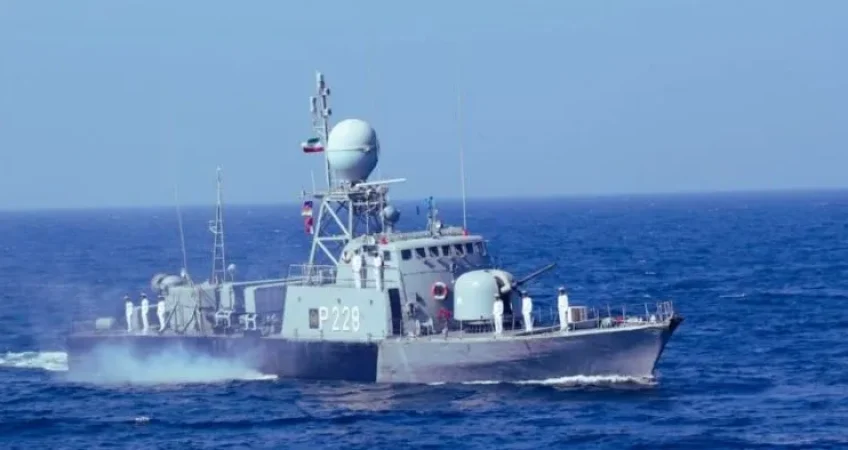
[Advantage Logistics] The crisis at the Strait of Hormuz has entered its 46th day as the US naval blockade targeting Iranian ports officially takes effect. Amid efforts to re-establish diplomatic backchannels, the International Maritime Organization (IMO) has issued warnings regarding legal risks and maritime safety, while analysts express deep concern over a severe decline in the global tanker market.
Hopes for a diplomatic solution flickered on Tuesday when Pakistan announced a proposal for a second round of negotiations between Washington and Tehran. Multiple officials confirmed that discussions for a new round of direct talks are underway – even as the US naval blockade of Iranian ports enters its second day and the Strait of Hormuz crisis approaches the 50-day mark.
Escalating Tensions Despite Active Backchannels
Pakistani Prime Minister Shehbaz Sharif offered a cautiously optimistic view, telling his cabinet: “the ceasefire is still holding and, as I speak, full efforts are underway to resolve the outstanding issues.”
This announcement follows the collapse of talks in Islamabad last weekend – led by US Vice President JD Vance, Special Envoy Steve Witkoff, and Jared Kushner – which concluded without an agreement. The direct consequence was US President Donald Trump declaring a naval blockade on Sunday.
Even as warships tighten the encirclement, Trump signaled that Tehran is eager to return to the negotiating table. Speaking to reporters outside the Oval Office on Monday, he asserted: “I can tell you that we’ve been called by the other side. They’d like to make a deal. Very badly, very badly.” However, he did not specify which Iranian official had made contact.
Conversely, Iranian Foreign Minister Abbas Araghchi reacted strongly, blaming Washington for the breakdown. According to the Iranian Foreign Ministry, during a phone call with his Saudi counterpart, Araghchi stated: “Unfortunately, we witnessed the continued excessive demands of the American side in the negotiations, which led to the failure to achieve a result.”
The IMO Speaks Out: Operational Implications and Legal Aspects
International Maritime Organization (IMO) Secretary-General Arsenio Dominguez delivered his most stringent remarks since the onset of the crisis on Monday. At a press briefing in London, he emphasized that the blockade is exacerbating a humanitarian crisis for seafarers.
Responding to whether the US blockade further complicates the IMO’s efforts to evacuate stranded seafarers and vessels, Dominguez was blunt: “De-escalation is what is going to start helping us to address the crisis and to bring shipping back to the way that we used to operate. Additional restrictive measures do not really help us.”
Addressing the legal aspects of the blockade, the IMO chief firmly asserted: “From a legal perspective, in accordance with international law, there is no right to prohibit the right of innocent passage, nor to impede the freedom of navigation through international straits used for international transit.”
Military Warnings and Gulf-Wide Contagion Risks
The US blockade (effective from 14:00 GMT on Monday) applies to all vessels entering or leaving Iranian coastal areas and ports along the Arabian Gulf and the Gulf of Oman. Although US Central Command (CENTCOM) pledged that vessels transiting between non-Iranian ports would not be impeded, President Trump issued a stark warning on social media that any Iranian fast attack craft approaching the blockade zone would be “immediately ELIMINATED.”
Retaliating against this move, Tehran issued a series of sweeping threats. Iranian state media declared: “Security in the Persian Gulf and the Sea of Oman is either for everyone or for NO ONE.” Simultaneously, the country’s military warned that “no port in the region will be safe.” Underscoring this stance, Iranian Parliament Speaker Mohammad Bagher Qalibaf sent a direct message to Trump: “If you fight, we will fight.”
Supply Chain in Crisis: Signs of “Demand Decline”
As the crisis nears its 50th day, French shipbroker BRS has sounded the alarm regarding looming economic consequences.
“Oil demand destruction is unequivocally starting to rear its ugly head, especially in developing Asia,” the BRS report highlighted, noting that fuel price protests across Europe serve as evidence that the price shock is spreading far beyond the region.
BRS warned that the longer the Strait of Hormuz remains frozen, the more aggressively the global market will have to react to establish a new equilibrium. “Given that outside the IEA members and China, oil inventories generally remain small, it appears that as these are exhausted, so the call on demand destruction to balance markets intensifies.”
The ultimate consequence of this domino effect, BRS cautioned, is that the outcome “could significantly curb global crude and product tanker demand.”
Source: Phaata.com (According to Splash247)
>> Other news:
>> 4 main types of services of Advantage Logistics:
>> Our contact:
-
-
- Address: 3rd Fl., 55 Nguyen Van Giai Str., Tan Dinh Ward, HCMC, Vietnam.
- Email: nicky@advantage.vn / truc@advantage.vn
- Hotline (cell/ zalo/ viber): 0909.054.866 (Mr.Quyền) / 0938.444.043 (Mr.Trực)
- Web: https://advantage.vn
-


