
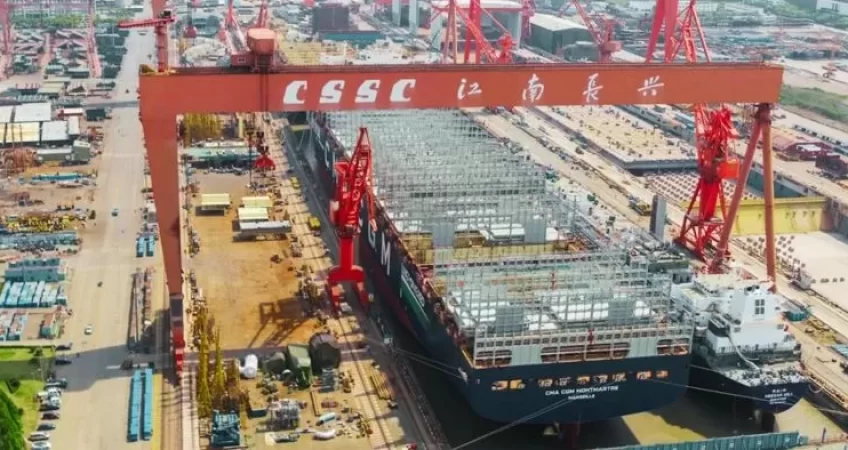
China’s shipbuilding market share fell sharply in the first half of 2025, partly due to concerns over new US port fees, according to a report from BIMCO.
According to the latest report from BIMCO, the world’s largest shipping association, the market share of Chinese shipyards fell from 72% to 52% in the first half of 2025, amid growing concerns about the impact of port fees imposed by the United States Trade Representative (USTR) on Chinese vessels.
BIMCO said that the USTR port fees, which are expected to take effect in October 2025, will impact both Chinese shipowners and operators, as well as vessels built in China.
Smaller vessels built in China will be exempted, subject to industry-specific criteria, along with exemptions for short-haul voyages.
Global new shipbuilding contracting activity in the first half of 2025, measured by gross tonnage (CGT), fell 54% year-on-year. Contracting slowed significantly for bulk carriers, oil tankers and gas carriers amid weaker freight rates. Containerships and cruise ships were the only major segments to see an expansion in contracting.
“In the first half of 2025, China’s share of newbuilding contracting fell to 52% from 72% in the previous six months. Growing concerns over USTR port fees on Chinese ships in US ports likely contributed to a decrease in contracting in China. This trend was further amplified by a drop in global ship contracting and a shift in the types of ships being ordered,” said Filipe Gouveia, Director of Shipping Analysis at BIMCO.
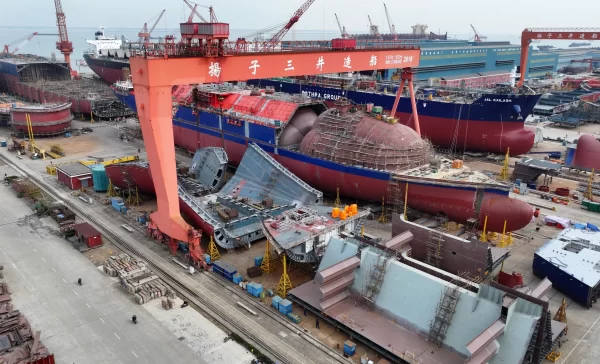
China retains its leading position in the global shipbuilding industry, absent only from the cruise ship segment. In 2024, gas tankers are the only segment where China ranks second after South Korea.
However, South Korea has also overtaken China in crude oil tanker construction so far this year.
“Even if shipowners try to avoid ordering ships in China due to USTR fees, there is a limit to the capacity available outside of the country. Consequently, if global ship contracting had not significantly dropped during the start of the year, China’s share of contracting would have likely been larger,” Gouveia added.
The capacity constraints have resulted in a large order book with long lead times, especially for larger vessels and for containerships, gas carriers and cruise ships. Of the contracts signed this year, 31% are expected to be delivered by 2027, 38% by 2028 and 23% thereafter.
South Korea and Japan are the second and third largest shipbuilding nations, respectively, but they face challenges in expanding production capacity. Both countries are experiencing labor shortages due to declining populations. This has led to higher labor costs, affecting their competitiveness.
“China’s dominant position in shipbuilding is unlikely to significantly change soon, but the country could face increasing competition in the medium term. Countries like the Philippines and Vietnam, already small-scale producers of bulkers and tankers, may boost their output, benefiting from low labour costs.”
“Meanwhile, although the US and India currently have limited shipbuilding capacity, both governments are actively working to strengthen their domestic industries. However, even if they succeed, it will take time for them to scale up production,” Mr. Gouveia concluded.
Source: Phaata.com (According to Marine Link)
>> Other news:
>> 4 main types of services of Advantage Logistics:
>> Our contact:
-
-
- Address: 3rd Fl., 55 Nguyen Van Giai Str., Tan Dinh Ward, HCMC, Vietnam.
- Email: nicky@advantage.vn / truc@advantage.vn
- Hotline (cell/ zalo/ viber): 0909.054.866 (Mr.Quyền) / 0938.444.043 (Mr.Trực)
- Web: https://advantage.vn
-


