
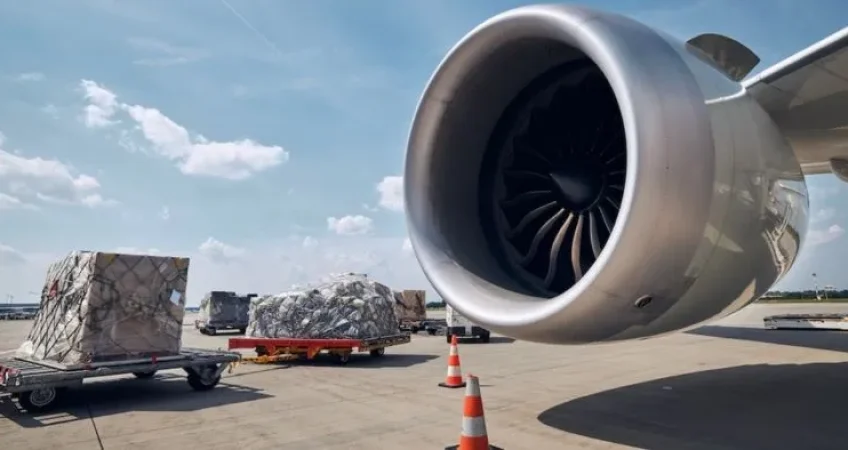
The ongoing disruption of air freight chains in the Middle East is exposing the fragility of the food supply systems in Gulf Cooperation Council (GCC) countries, directly driving up logistics costs and consumer prices.
For a region whose economic structure is deeply reliant on imported food, the fallout from airspace disruptions extends far beyond short-term price volatility. This reality starkly reveals how modern food systems are inextricably tied to the efficiency of air logistics, particularly for high-value and time-sensitive commodities.
Air Freight: The Lifeblood of the Food Supply Chain
The Gulf Cooperation Council (GCC) remains heavily dependent on imported food, with a significant proportion of perishables and premium goods transported by air. Fresh produce, dairy, seafood, and specialty items require ultra-short transit times and strictly controlled handling processes, making air freight an irreplaceable link.
Under stable conditions, flight corridors connecting Europe, South Asia, and parts of Africa provide highly predictable supply flows. This network allows retailers and distributors to operate lean inventory models while ensuring product freshness and availability.
Rerouting Pressures and Capacity Shocks
However, that equilibrium is now being severely stretched. Airlines are being forced to reroute flights to bypass sensitive airspace in the Middle East, prolonging flight times and complicating network planning.
The cascading operational consequences – ranging from higher fuel burn and strained crew resources to reduced aircraft utilization – are bleeding directly into cargo capacity and freight rates. The impact is also fragmented: belly capacity on passenger flights shows relative stability, whereas dedicated freighter operations bear the direct brunt of rerouting inefficiencies. Consequently, immense pressure is mounting on capacity segments, particularly for temperature-controlled cargo.
Escalating Freight Costs Bleed into Retail Prices
The immediate effect of disrupted flight corridors is a tightening of available capacity on key routes funneling into the Gulf. Meanwhile, the import demand for perishables is highly inelastic, forcing freight rates to automatically adjust upward in line with supply and demand dynamics.
From a logistics perspective, this mechanism plays out very directly: longer routes drive up operational costs, while reduced actual capacity limits available space. This imbalance triggers skyrocketing freight rates, felt most acutely in time-sensitive segments.
Importers – trapped between razor-thin margins and fixed commitment windows with retailers – have very little room to absorb these increased costs themselves. These costs are inevitably passed down the supply chain – from importers, through distributors, to retailers – before landing directly on the consumer. This ripple effect is most evident in product categories where air freight accounts for a large proportion of the total landed cost.
The Fragile Equilibrium of the Cold Chain and Operational Risks
Beyond the cost equation, prolonged transit times are creating tangible operational risks. Shortened shelf lives increase the risk of spoilage and inventory shrinkage, further squeezing profit margins. Importers are facing a double whammy: higher freight costs coupled with lower recovery rates.
In response, procurement strategies are being fine-tuned, including actively altering volumes, shifting sourcing origins, and tightening inventory management. In some cases, even the slightest delay can wipe out the commercial viability of highly perishable goods. The result is a negative feedback loop: lower product availability, rising input costs, and retail prices anchored at high levels – a testament to the fragility of a system optimized solely for efficiency under stable conditions.
The Limits of Modal Shifts
In theory, multimodal transport is the saving grace. In practice, however, modal shifts face myriad hurdles. Ocean freight offers lower rates but lacks speed – a vital factor for perishables. Transitioning from air to ocean freight requires a complete redesign of sourcing processes, packaging, and inventory strategies – things that cannot be executed overnight.
Road transport options are similarly constrained by geography, cross-border infrastructure, and complex regulatory barriers. In many Gulf markets, these modes serve only a supplementary role and cannot replace air freight in critical cargo segments.
Macroeconomic Impacts and Strategic Restructuring
These disruptions do not stop at the borders of the supply chain; they are bleeding into the macroeconomic picture. The escalation of food prices contributes directly to overall inflation.
This situation is prompting a comprehensive reassessment of supply chain strategies across the Gulf. Importers and Logistics Service Providers (LSPs) are aggressively seeking diversification in both sourcing and routing to minimize reliance on single corridors. Investment flows into cold chain infrastructure, inventory buffers, and supply chain visibility are surging, bolstered by digital tools designed to accelerate operational response times.
A New Perception of Logistics Positioning
The current landscape is reshaping the role of air freight in the Gulf’s food supply chain. Air cargo is no longer merely a premium transport option; it has become a core component ensuring supply stability amidst volatility.
For the air freight industry, this situation reaffirms the vital importance of network flexibility, alternative routing, and deep integration with multimodal transport. As long as geopolitical volatility persists, the reliability of air networks will serve not only as a benchmark of logistics capability but also as a decisive factor in the region’s economic stability and food security.
The volatility of freight rates and the stability of supply will depend on how long and how severe this geopolitical rupture becomes. Airlines’ ability to optimize alternative routes without incurring complex operational risks will be a pivotal factor. For stakeholders, maintaining the continuity of cargo flows is the top priority. The Gulf is facing a new reality: national food security now hinges directly on the resilience of air networks. When flight corridors are paralyzed, the pressure is no longer confined to the forwarder’s cost sheet, but translates into an existential crisis on every retail shelf.
Source: Phaata.com (According to Air Cargo Week)
>> Other news:
>> 4 main types of services of Advantage Logistics:
>> Our contact:
-
-
- Address: 3rd Fl., 55 Nguyen Van Giai Str., Tan Dinh Ward, HCMC, Vietnam.
- Email: nicky@advantage.vn / truc@advantage.vn
- Hotline (cell/ zalo/ viber): 0909.054.866 (Mr.Quyền) / 0938.444.043 (Mr.Trực)
- Web: https://advantage.vn
-


